
Revelation Beach. Book club questions for discussion.
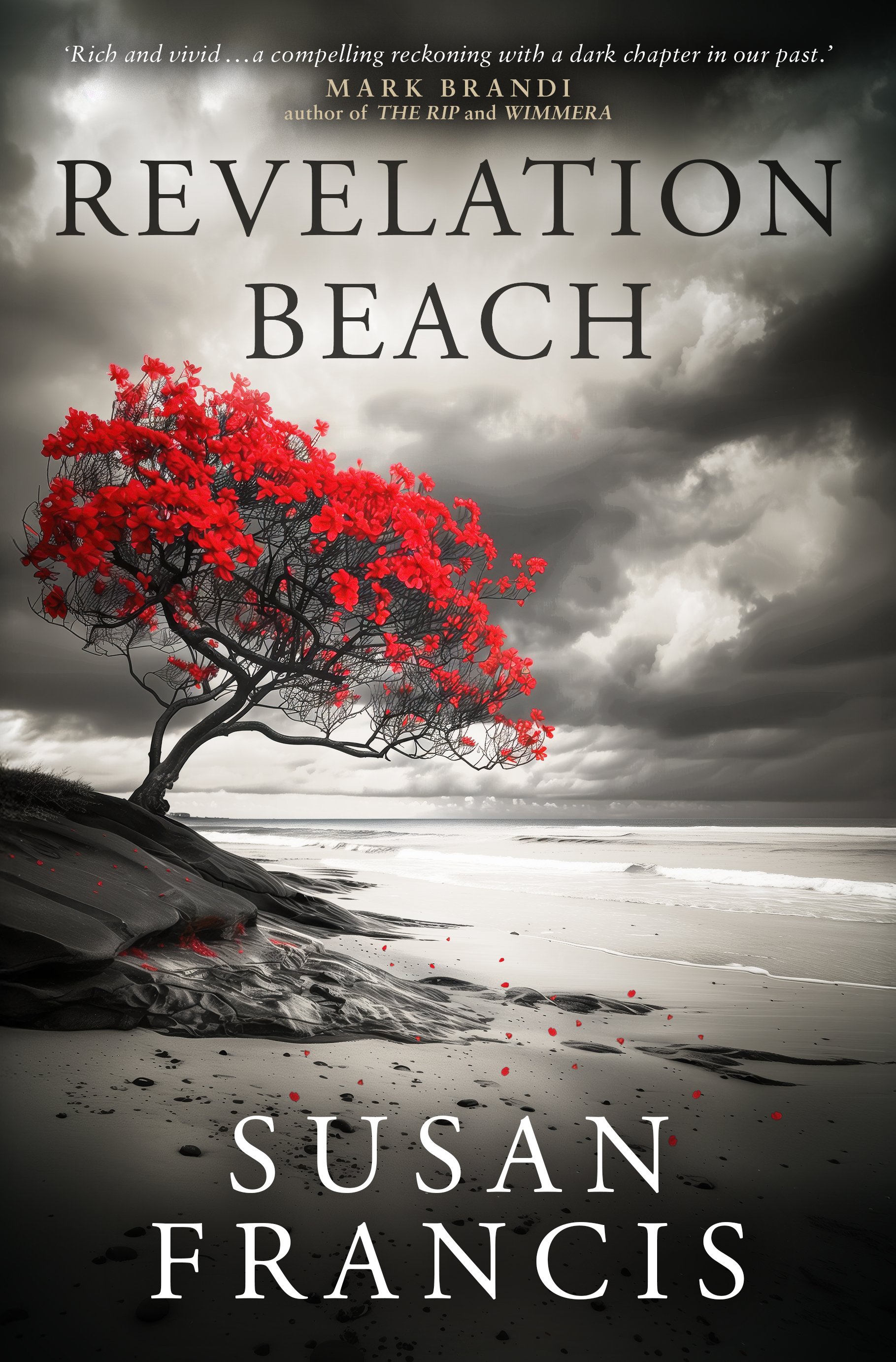
Revelation Beach by Susan Francis is a gripping literary thriller set against one of the most troubling chapters in Australia’s modern history. Beginning with the suspicious death of Eleanor Freeman’s stepmother, Ida, the novel unfolds into a decades-spanning reckoning with secrecy, political betrayal and moral compromise surrounding the deaths of the Balibo Five in East Timor.
The book invites readers to reflect on truth, silence, loyalty and survival in both personal and political spheres. The questions below explore the novel’s historical undercurrents, its complex characters and the moral tensions at its heart.
Revelation Beach. Book club questions for discussion.
1. Why do you think Susan Francis has written about the Balibo Five in fictional form rather than providing a factual account? What are the rewards and/or drawbacks of her using the thriller genre to retell the journalist’s story?
2. The female characters in Revelation Beach are all complex women striving to improve their own world and that of others. By comparison, the men represent the less noble traits of humankind. Do you think this makes the novel more weighted towards a female audience? Does Francis manage to balance the two sides of good and evil in equal measure?
3. Despite the betrayals and tragedy depicted in the novel it is still essentially a book about love. Do you agree? And if so, what kind of love is explored, and between whom? Is the book ultimately hopeful?
4. The novel is set between Australia, Java and East Timor, and across a number of decades. Which descriptions of time and place did you enjoy, and lose yourself in, the most?
5. What makes the novel ‘a thriller’?
6. Eleanor and Clare's experiences in East Timor are life changing. ‘I never knew Dili would be like this. (p.138) How does the relationship between Eleanor and Clare begin? Why does it alter? What is it between them that attracts one to the other?
7. Is this a quintessentially Australian story? Why or why not?
8. Is Ida or Eleanor's perspective stronger? Did you identify with one character’s experience more than the other’s?
9. Eleanor mostly survives by keeping herself detached from emotional relationships. She learnt early from Ida, and from her own tragic experiences, that no-one else can really be relied on. Do you agree?
10. Ida embodies the old-fashioned quality of 'duty'. In part, Eleanor also tries her hardest to show fealty. And yet for both women, this ideal can prove to be dangerous. Is duty a value that is dying out in our society? How important do you see it?
11. Although Ida never has children of her own, she understands and acts in a moral way regarding her responsibility for both Eleanor and Francisca. How is motherhood portrayed in the novel? What conclusions do you draw from the fact that Eleanor had no children.
12. The frontispiece in Revelation Beach quotes Elie Wiesel, 'What hurts the victim the most is not the cruelty of the oppressor, but the silence of the bystander.’ What do you understand this statement to mean and how can it be applied to the plot and characters of the novel?
13. There are obvious parallels between Ida and Eleanor. What are the differences?
14. Both Eleanor and Ida interpret for others. They are skilled at it and recognised for their ability. Discuss the importance of using words to witness genocide and the costs people pay for watching other people’s horror, or for speaking out.
15. There are a number of repeated symbols throughout the novel such as fire, flame trees, birds and bats. What do they represent?
16. Both Stuart and Clive play the role of the villain in Revelation Beach. But what of Eleanor’s natural father, Harry? How do you judge Harry for never telling Eleanor that he was her father?
17. Francis has stated that her purpose in writing Revelation Beach was to remind the Australian public about the Balibo Five. Was this a new piece of our history for you, or did you already know a lot about it? What surprised you? Were you angry?
18. How important do you think it was, for Eleanor to finally know that Ida did nothing immoral in the time that she was missing? Did you believe that Ida was innocent?
19. What do you think is the most important theme to emerge from Revelation Beach?
20. In their own ways, both Ida and Eleanor are survivors. How is it so? What aspects of their stories make them heroic?
Susan Francis
When Eleanor Freeman’s enigmatic stepmother, Ida, dies in a suspicious fire, a lifetime of secrets begins to unravel. Was Ida an Indonesian spy entangled in the murders of the Balibo Five and unspeakable war crimes?
Haunted by the past and pursued by those who would prefer the truth to remain buried, Eleanor flees to a crumbling lighthouse on the mid-north coast of NSW. There, amid salt-lashed cliffs and gathering shadows, she unearths a decades-old conspiracy of betrayal, silence and bloodshed – one that stretches from the halls of Canberra to the ravaged villages of Timor-Leste.
Revelation Beach dares to expose one of Australia’s most shameful cover-ups, where lives were sacrificed for oil, gas and political expediency. At once a literary page-turner and a powerful reckoning, this novel asks the question: How far would you go to uncover the truth?
_________
Susan Francis spent a year in Indonesia in 1980, where she experienced conversations shutting down when she walked into social settings and witnessed chunks of articles in the newspapers blacked out by the censor’s heavy hand as ongoing resistance by the Timorese filled the media. This led her to years of researching this bloody history. In Revelation Beach, Susan intricately weaves fact with fiction to highlight our crucial relationship with our northern neighbours and the devastation when we chose to look away from genocide. With the fiftieth anniversary of the journalists’ deaths in October 2025, Revelation Beach showcases one of the greatest government cover-ups in Australian history.

Read more about Susan Francis here.