
 Image 1 of 2
 Image 2 of 2
-
2018 | 9780648066361 | 282 pages | Paperback | 254 x 154 mm | Memoir
-
Palestine, conflict, history, refugees, migrant stories, memoir
-
-
Praise for Tears for Tarshiha
‘For too long, Palestinians have remained largely invisible in our media and demonised as terrorists. It's therefore wonderfully refreshing to read the history, reflections and passions of Olfat Mahmoud and understand what exile still means for millions of Palestinians around the world, refused access to their former homeland. I commend this book for its humanity and quest for justice. The Middle East will not see peace until these issues are resolved.’
—Antony Loewenstein, independent journalist, film-maker, author of Disaster Capitalism and My Israel Question
Olfat Mahmoud, a stateless refugee, is a descendant of the ‘forgotten Palestinians’, forced from their homes by the Israeli military in 1948. A former nurse, NGO director and academic, Mahmoud’s confronting autobiography asks when the world will deliver on its promise and allow her people to return home.
“Olfat Mahmoud has long been a passionate, compassionate and articulate voice for Palestinian refugees. Her account of the agony of dispossession and exile – not least the horror of the murderous assaults on the Sabra Shatila and Borj el-Barajneh camps in Lebanon in the 1980s which she so bravely lived through – is both scarifying and deeply moving. No one of any humanity could fail to be touched by this book”
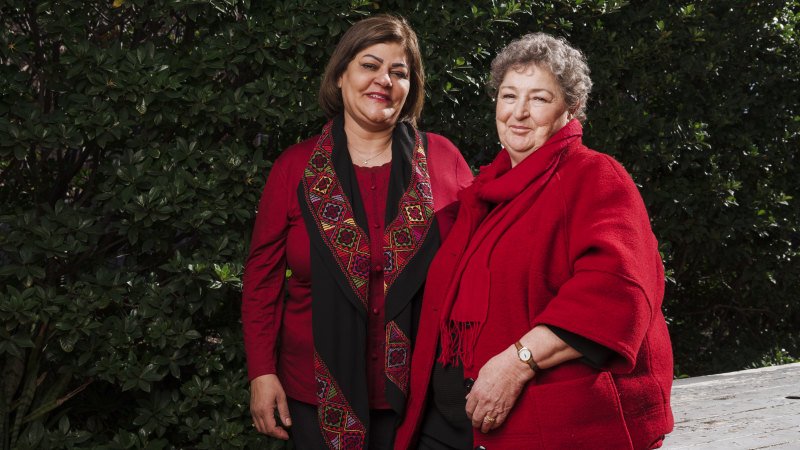
Dr. Olfat Mahmoud was born in a refugee camp in Lebanon. Olfat started her career as a nurse, then became a nurse educator, later joining the Faculty of Human Sciences at Beirut Arab University, earning a PhD in Psychology. Read more.
CONTRIBUTORS
Dani Cooper has worked as a senior journalist on national newspapers in the UK, Ireland and Australia, including as Foreign News Editor at The Australian. For the past decade she has worked as a freelance science journalist, editor and writer. She has previously written Livelihoods and Liberation Struggles – the history of the ACTU’s aid agency, APHEDA-Union Aid Abroad.
Dr Helen McCue AM first worked closely with Palestinian refugees when working as a nurse consultant with the United Nations World Health Organisation in the Middle East. McCue initiated and co-founded the international aid arm of the ACTU, APHEDA-Union Aid Abroad, and Rural Australians for Refugees (RAR), and has worked extensively with both organisations. McCue completed her PhD in 2000 and has worked at the University of Melbourne’s Islamic Centre of Excellence in Islamic Studies and the University of Sydney’s Law Faculty where her major research focus is Muslim women in Australia. She has published a number of academic papers and chapters, and co-authored Family Law and Australian Muslim Women with Abdullah Saeed. McCue has received several national and international awards including an Order of Australia for her human rights, refugee and humanitarian work.